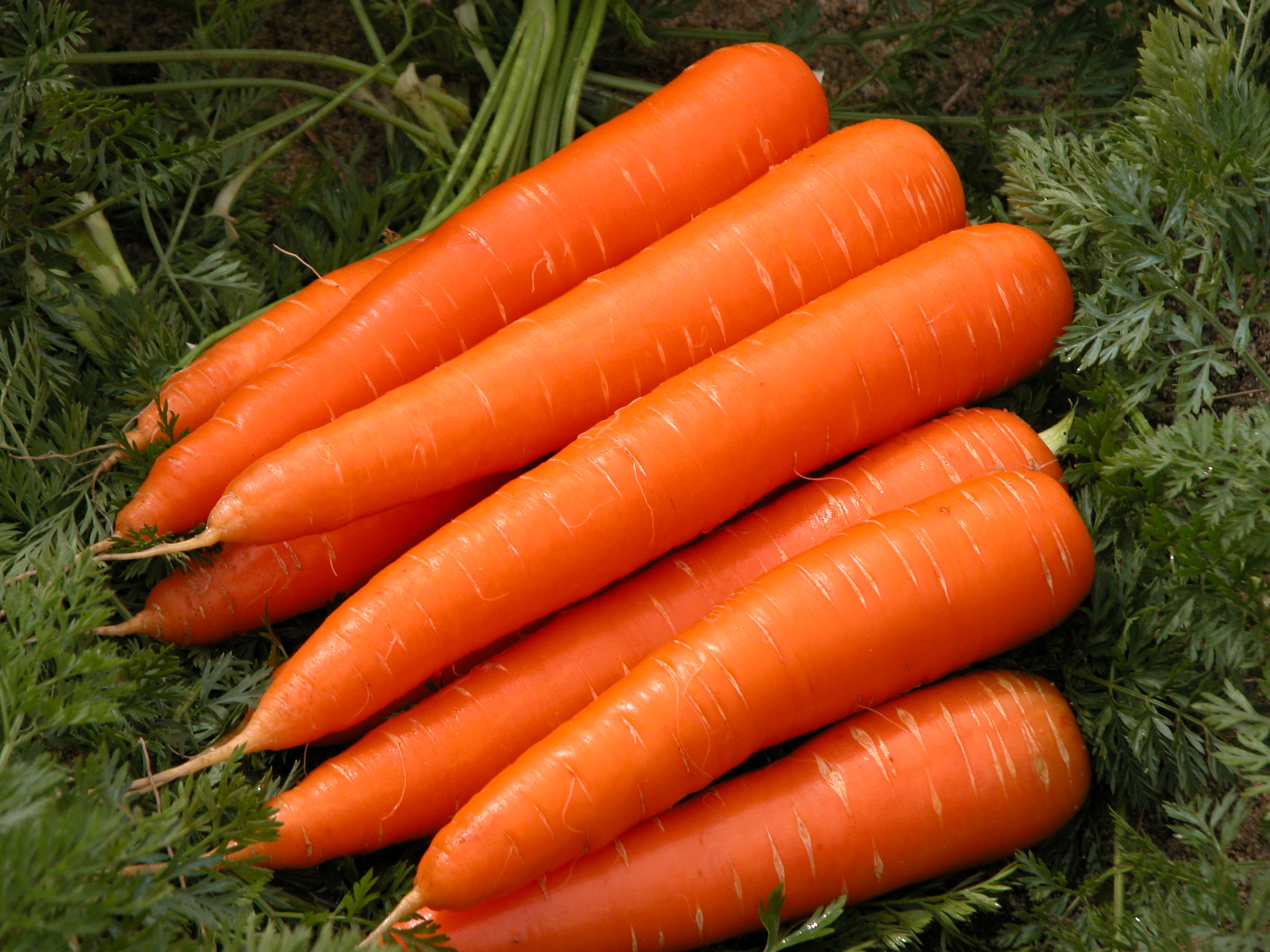
| PRIMARY MICRO NUTRIENTS | Vitamin A, Vitamin K, Biotin |
| SECONDARY MICRO NUTRIENTS | Vit C, B1, B6, Potassium |
| NUTRITIONAL HIGHLIGHTS and NOTES | Highest source of provitamin A carotenes. Cooking enhances the bioavailability of beta-carotene (by breaking down the fiber) |
| FUNCTIONAL BENEFITS | |
| PHYTONUTRIENTS | Carotene
Beta-carotene
|
| PLANT FAMILY | Umbelliferae. Related to: Carrots, Celery, Parsnips, Parsley, Fennel, Dill |
| DANGERS | High pesticide levels; very high doses over long periods of time shown to lead to menstrual problems and decrease in white blood cell numbers |
| RDA | Carrots, raw | % RDA | Carrots, cooked | % RDA | ||
| Nutrient | Unit | per 100g | per 100g | |||
| Water | g | 88.29 | 90.17 | |||
| Energy | kcal | 41 | 35 | |||
| Protein | g | 0.93 | 0.76 | |||
| Total lipid (fat) | g | 0.24 | 0.18 | |||
| Carbohydrate, by difference | g | 9.58 | 8.22 | |||
| Fiber, total dietary | g | 2.8 | 3 | |||
| Sugars, total | g | 4.74 | 3.45 | |||
| Minerals | ||||||
| Calcium, Ca | mg | 1000 | 33 | 3.3% | 30 | 3.0% |
| Iron, Fe | mg | 8 | 0.3 | 3.8% | 0.34 | 4.3% |
| Magnesium, Mg | mg | 420 | 12 | 2.9% | 10 | 2.4% |
| Phosphorus, P | mg | 700 | 35 | 5.0% | 30 | 4.3% |
| Potassium, K | mg | 470 | 320 | 68.1% | 235 | 50.0% |
| Sodium, Na | mg | 69 | 58 | |||
| Zinc, Zn | mg | 11 | 0.24 | 2.2% | 0.2 | 1.8% |
| Copper, Cu | mg | 0.9 | 0.045 | 5.0% | 0.017 | 1.9% |
| Manganese, Mn | mg | 2.3 | 0.143 | 6.2% | 0.155 | 6.7% |
| Selenium, Se | µg | 55 | 0.1 | 0.2% | 0.7 | 1.3% |
| Vitamins | ||||||
| Vitamin C, total ascorbic acid | mg | 90 | 5.9 | 6.6% | 3.6 | 4.0% |
| Thiamin | mg | 1.2 | 0.066 | 5.5% | 0.066 | 5.5% |
| Riboflavin | mg | 1.3 | 0.058 | 4.5% | 0.044 | 3.4% |
| Niacin | mg | 16 | 0.983 | 6.1% | 0.645 | 4.0% |
| Pantothenic acid | mg | 5 | 0.273 | 5.5% | 0.232 | 4.6% |
| Vitamin B-6 | mg | 1.7 | 0.138 | 8.1% | 0.153 | 9.0% |
| Folate, total | µg | 400 | 19 | 4.8% | 14 | 3.5% |
| Choline, total | mg | 8.8 | 8.8 | |||
| Betaine | mg | 0.4 | 0.1 | |||
| Vitamin B-12 | µg | 2.4 | 0 | 0.0% | 0 | 0.0% |
| Vitamin A, IU | IU | 5000 | 16706 | 334.1% | 17033 | 340.7% |
| Vitamin E, total | mg | 15 | 0.67 | 4.5% | 1.06 | 7.1% |
| Vitamin D | IU | 600 | 0 | 0.0% | 0 | 0.0% |
| Vitamin K (phylloquinone) | µg | 120 | 13.2 | 11.0% | 13.7 | 11.4% |
The Recommended Dietary Amount (RDA) is based upon recommendations for a 40 year old very active man that I have adapted from USDA’s Dietary Intake Recommendations: http://fnic.nal.usda.gov/fnic/interactiveDRI/. Using this link you can make your own calculationsNotes:
Adapted from:
Murray, M. (2005). Encyclopedia of Healing Food. New York, N.Y.: Atria Books
Pitchford, P. (2002). Healing With Whole Foods: Asian Traditions and Modern Nutrition, North Atlantic Books
USDA food database: http://ndb.nal.usda.gov/ndb/
Other information sources:
Online database of the World’s Healthiest Foods: http://www.whfoods.com/index.php
Online nutrient breakdown of foods: http://nutritiondata.self.com/

 ELATE! - Evolve, Love And Transform Everyday!