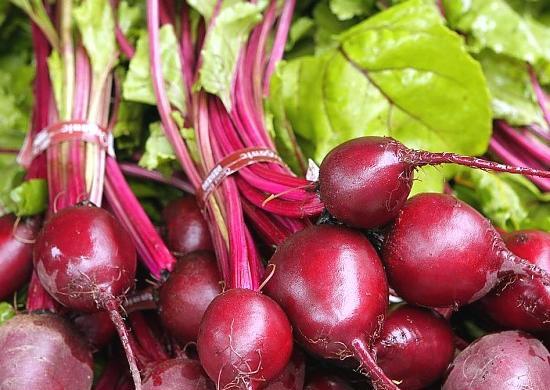
| PRIMARY MICRO NUTRIENTS | Calcium, Iron, vitamins A and C (these are highest in Beet Leaves); Folic acid, Manganese, Potassium, Silicon (highest in Beet Roots) |
| SECONDARY MICRO NUTRIENTS | Magnesium, Phosphorus, Iron and Vit B6 |
| NUTRITIONAL HIGHLIGHTS and NOTES | Detox aid and Anti-Cancer
A silicon-rich vegetable Neutral thermal nature; sweet flavor; strengthens the heart, sedates the spirit, improves circulation, purifies the blood, benefits the liver, moistens the intestines, and promotes menstruation. |
| FUNCTIONAL BENEFITS | Liver health
Used with carrots for hormone regulation during menopause Treats
|
| PHYTONUTRIENTS | Betacyanin (pigment) – Cancer fighting: inhibits formation of cancer causing nitrosamines |
| PLANT FAMILY | Chenopodiaceae. Related to: Beets, Spinach, Swiss Chard |
| DANGERS | Oxalates (Calcium binding and Kidney stones); large amounts of beet juice can upset the stomach
Caution: The greens contain abundant oxalic acid, and if eaten excessively, inhibit calcium metabolism. |
| RDA | Beet greens, raw | % RDA | Beets, cooked, boiled | % RDA | ||
| Nutrient | Unit | per 100g | per 100g | |||
| Water | g | 91.02 | 87.06 | |||
| Energy | kcal | 22 | 44 | |||
| Protein | g | 2.2 | 1.68 | |||
| Total lipid (fat) | g | 0.13 | 0.18 | |||
| Carbohydrate, by difference | g | 4.33 | 9.96 | |||
| Fiber, total dietary | g | 3.7 | 2 | |||
| Sugars, total | g | 0.5 | 7.96 | |||
| Minerals | ||||||
| Calcium, Ca | mg | 1000 | 117 | 11.7% | 16 | 1.6% |
| Iron, Fe | mg | 8 | 2.57 | 32.1% | 0.79 | 9.9% |
| Magnesium, Mg | mg | 420 | 70 | 16.7% | 23 | 5.5% |
| Phosphorus, P | mg | 700 | 41 | 5.9% | 38 | 5.4% |
| Potassium, K | mg | 470 | 762 | 162.1% | 305 | 64.9% |
| Sodium, Na | mg | 226 | 77 | |||
| Zinc, Zn | mg | 11 | 0.38 | 3.5% | 0.35 | 3.2% |
| Copper, Cu | mg | 0.9 | 0.191 | 21.2% | 0.074 | 8.2% |
| Manganese, Mn | mg | 2.3 | 0.391 | 17.0% | 0.326 | 14.2% |
| Selenium, Se | µg | 55 | 0.9 | 1.6% | 0.7 | 1.3% |
| Vitamins | ||||||
| Vitamin C, total ascorbic acid | mg | 90 | 30 | 33.3% | 3.6 | 4.0% |
| Thiamin | mg | 1.2 | 0.1 | 8.3% | 0.027 | 2.3% |
| Riboflavin | mg | 1.3 | 0.22 | 16.9% | 0.04 | 3.1% |
| Niacin | mg | 16 | 0.4 | 2.5% | 0.331 | 2.1% |
| Pantothenic acid | mg | 5 | 0.25 | 5.0% | 0.145 | 2.9% |
| Vitamin B-6 | mg | 1.7 | 0.106 | 6.2% | 0.067 | 3.9% |
| Folate, total | µg | 400 | 15 | 3.8% | 80 | 20.0% |
| Choline, total | mg | 0.4 | 6.3 | |||
| Betaine | mg | 0 | ||||
| Vitamin B-12 | µg | 2.4 | 0 | 0.0% | 0 | 0.0% |
| Vitamin A, RAE | mcg | 900 | 382.7 | 42.5% | 316 | 35.1% |
| Vitamin E, total | mg | 15 | 1.5 | 10.0% | 0.04 | 0.3% |
| Vitamin D | IU | 600 | 0 | 0.0% | 0 | 0.0% |
| Vitamin K (phylloquinone) | µg | 120 | 400 | 333.3% | 0.2 | 0.2% |
Notes:
The Recommended Dietary Amount (RDA) is based upon recommendations for a 40 year old very active man that I have adapted from USDA’s Dietary Intake Recommendations. Using this link you can make your own calculations
Adapted from:
Murray, M. (2005). Encyclopedia of Healing Food. New York, N.Y.: Atria Books
Paul Pitchford (2002). Healing With Whole Foods: Asian Traditions and Modern Nutrition, North Atlantic Books
USDA food database: http://ndb.nal.usda.gov/ndb/
Other information sources:
Online database of the World’s Healthiest Foods
Online nutrient breakdown of foods: http://nutritiondata.self.com/

 ELATE! - Evolve, Love And Transform Everyday!